The Giving Pledge Reality Check
No Billionaire Left Behind Series – Part 2

By Stephan Onisick
(AI contributed to research. Formatting and drafting; all analysis, framing, and conclusions are my own.)
Introduction
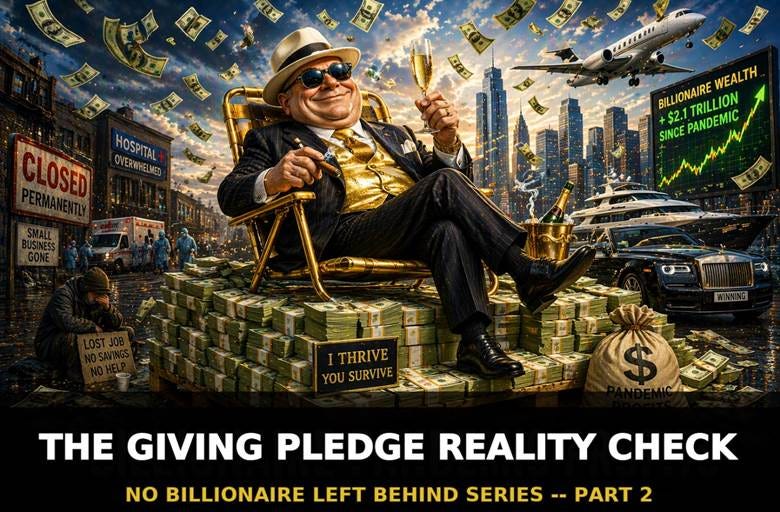
During the COVID-19 pandemic, billions of people faced illness, unemployment, business closures, and economic uncertainty. At the same time, many of the world’s richest individuals saw their fortunes soar to unprecedented heights — the pandemic years produced the largest and fastest increase in billionaire wealth on record.
For over a decade, the Giving Pledge — the public promise, signed by more than 250 of the world’s wealthiest people, to give away the majority of their fortunes — has offered reassurance that extreme wealth would eventually be returned to society through large-scale philanthropy.
That surge of wealth is the starting point for this article. The pledge asks signatories to give away the majority of their fortunes — and during the pandemic, those fortunes grew faster than at any point on record.
My last article outlined that there was not much giving that took place, with a few notable exceptions. Billionaire Pandemic Profits
This article looks at what the Giving Pledge actually asks of its signatories, and then measures that promise against what its own wealthiest members have delivered.
What was the Giving Pledge Anyway
The premise is simple. In June 2010, Bill Gates, Melinda French Gates, and Warren Buffett launched the Giving Pledge. He asked their fellow billionaires to do one thing: commit, publicly and in writing, to give away more than half of their fortune to charitable causes, either during their lifetime or through their estate.
The rules, such as they are, leave enormous room. There is no deadline. There is no minimum annual payout, no oversight body, and no legal mechanism to enforce a pledge once it is signed.
A signatory writes a personal letter explaining their commitment, and that letter — not a contract — is the entire enforcement mechanism. The pledge is also open to non-billionaires, provided they are prepared to give away at least $500 million.
A signatory writes a personal letter explaining their commitment, and that letter — not a contract — is the entire enforcement mechanism.
Fifteen years later, the pledge has grown steadily, if unevenly. In its first year, 57 US individuals, couples, and families signed on, representing roughly 14% of America’s billionaires at the time. Today the roster has grown to 256 signatories across 30 countries, with combined pledged wealth estimated above $1 trillion.
The moral model behind the pledge predates it. Gates and Buffett have pointed to Chuck Feeney, the billionaire founder of Duty Free Shoppers, as the template: Feeney gave away virtually his entire $8 billion fortune before he died in 2023, living modestly and often anonymously under a philosophy he called “giving while living.”
The Giving Pledge asks signatories to aspire to that example. Whether they have is a separate question — and it’s the one this article turns to next.
What were the Results
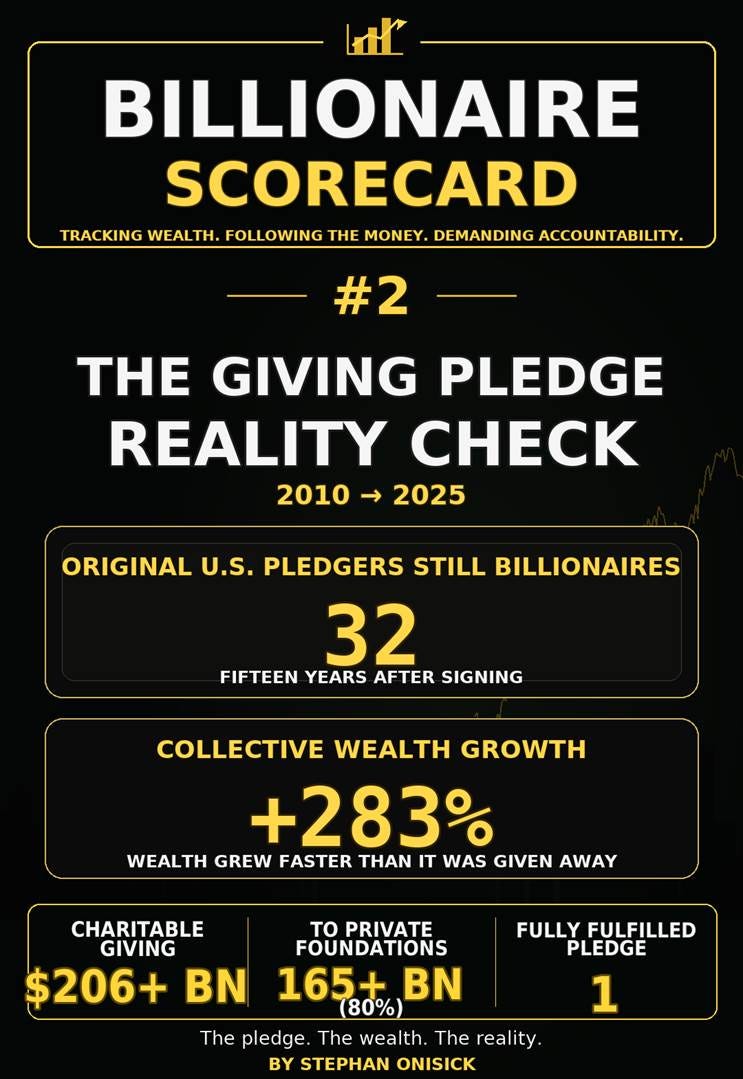
Fifteen years in, the Institute for Policy Studies set out to answer that question directly. Its report, The Giving Pledge at 15, tracked the 57 original 2010 US signatories and found a pattern that undercuts the pledge’s premise: the wealth has grown faster than the giving.
Thirty-two of those original signatories are still billionaires today. Collectively, their fortunes have grown 283% since they signed — now worth a combined $908 billion, an average of $28 billion per signatory. Over that same period, the group has given an estimated $206 billion to charity.
But “given to charity” and “reached a working charity” are not the same thing. Roughly 80% of that $206 billion — about $164 billion — went not to operating nonprofits but into private foundations, the vehicles discussed in the piece before this one.
As established there, private foundations are only required to distribute 5% of assets a year, meaning a dollar routed into a foundation can sit, invested and compounding, for decades before it reaches an actual charity. Another estimated $5 billion flowed into donor-advised funds, which carry no mandatory payout requirement at all.
The distinction is worth dwelling on, because a private foundation isn’t just a slower version of a direct gift — it’s a fundamentally different transaction. Give money to an existing charity and control of it is gone. Route the same money into a private foundation, and the donor keeps the money and control.
Give money to an existing charity and control of it is gone. Route the same money into a private foundation, and the donor keeps the money and control.
A private foundation is a freestanding legal entity the donor controls 100%, indefinitely. The donor and family sit on the board, decide which causes get funded and when, and can be paid “reasonable compensation” as officers or staff — all while salaries, travel, and office costs count toward the foundation’s 5% minimum payout rather than coming out of pocket.
None of that is available if the money goes to an existing charity. A foundation, by contrast, can become a family institution spanning generations — a name on buildings, a permanent board seat for children and grandchildren, a seat at the table of American philanthropy — funded by an initial gift that may never fully reach the people it was pledged to help.
By the report’s accounting, exactly one living 2010 signatory has technically fulfilled the pledge: Laura and John Arnold, who have given away an estimated $4.76 billion — mostly to their own foundation — against $2.93 billion remaining.
If every other living billionaire who signed in 2010 honored their commitment today, they would need to direct an additional $367 billion to charity — nearly matching the $392 billion given by every individual donor in the United States, combined, in 2024.
The record among deceased signatories is similarly uneven. Of the 22 Giving Pledgers who have died since 2010, only 8 gave away 50% or more of their wealth, whether during their lives or through their estates. Just one — Chuck Feeney, the pledge’s own inspiration — gave away the entirety of the fortune he pledged before he died.
Why Giving Doesn’t Reduce Corporate Wealth
The math behind the Giving Pledge’s shortfall isn’t only a foundation-payout problem. It’s also a capital gains problem.
Most billionaire wealth sits in stock that has never been sold, meaning the gain has never been taxed. Selling that stock to donate cash would trigger a capital gains tax bill. Donating the stock itself does not — the donor claims a deduction for the full market value, and the unrealized gain disappears for tax purposes.
Warren Buffett is the clearest illustration. Since 2006, he has donated more than $60 billion in Berkshire Hathaway stock to the Gates Foundation and four family charities — a sum larger than his entire net worth the year he started giving, when Berkshire shares made him worth roughly $46 billion. He has not sold a single share to fund any of it.
Yet Buffett is richer now than when he began. His remaining Berkshire stake was worth roughly $145 billion in mid-2025 — more than triple his 2006 net worth. Berkshire’s stock grew faster than Buffett could give it away.
MacKenzie Scott’s case is even more direct. Since her 2019 divorce from Jeff Bezos, she has given away more than $19 billion, mostly as outright, no-strings cash and stock grants — an unusually fast and unrestricted style of giving. It amounts to roughly 40% of the fortune she started with.
Her net worth has climbed anyway, to more than $34 billion. Amazon stock, the asset behind nearly all of her fortune, has risen over 47% since 2021 — appreciation that has replaced her donations faster than she can make them. In 2025 alone, market gains added close to $1 billion to her balance sheet, more than offsetting that year’s giving.
The pattern helps explain what the Giving Pledge numbers actually show: wealth compounding faster than pledges can be honored. These donors aren’t failing to give — several are giving on a historic scale. They’re giving from a well that refills itself.
They’re giving from a well that refills itself.
The Loan That Never Gets Paid
Giving isn’t the only thing that leaves these fortunes intact. Spending does too — as long as the spending is funded by debt instead of a sale.
A loan is not income, so borrowing against stock triggers no capital gains tax at all. The billionaire gets cash to spend; the shares stay put as collateral, continuing to compound the entire time the loan is outstanding.
A loan is not income, so borrowing against stock triggers no capital gains tax at all.
Larry Ellison is a longtime practitioner. Securities filings show he has pledged Oracle shares as collateral since at least 2007, and he went nearly a decade — from December 2010 to June 2020 — without selling a single share, even while spending $300 million on the Hawaiian island of Lanai and building a real estate portfolio worth more than $1 billion.
Elon Musk runs the same playbook at an even larger scale. He has pledged more than 88 million Tesla shares — worth over $94 billion — as collateral for lines of credit. This arrangement functions as a standing source of cash without ever triggering a taxable sale.
Tax scholars have a name for the pattern: “buy, borrow, die.” The first two steps are the mechanisms above. The third — dying with it — turns out to be the most powerful of all, and it deserves its own explanation.
Between giving and borrowing, the same block of stock can fund a foundation and a lifestyle indefinitely, without the sale that would shrink the fortune or the tax bill that would come with it.
The Gift That Keeps Giving
Even the portion of a fortune that’s never given away and never borrowed against has one more exit that avoids tax entirely: dying with it.
When someone dies holding appreciated stock, the capital gain built up over their lifetime disappears. Heirs inherit the shares at their value on the date of death, not the original purchase price — a reset called the “step-up in basis.” Sell the shares the next day, and there is no capital gains tax at all, even on a gain that may represent nearly the entire fortune.
A separate tax, the federal estate tax, could in theory claim a share of that fortune before it changes hands. But the exemption is large: $15 million per person, $30 million for a married couple, as of 2026, before the 40% top rate even applies. For most Americans, that exemption covers an entire estate. For a billionaire, it protects a fraction of one percent.
For the rest, wealthy families use trusts built to move the growth out of the taxable estate before it’s ever counted. A grantor retained annuity trust, or GRAT, lets someone place a block of stock in a trust for a couple of years, take back annuity payments roughly equal to what they put in, and let any appreciation pass to heirs — tax-free, without touching the estate tax exemption at all.
The structure is named for its test case. Audrey Walton, sister-in-law of Walmart founder Sam Walton, won a 2000 court ruling that validated the strategy, and the Walton family has used it aggressively since. An analysis of SEC filings found the Walton siblings ran at least 57 separate GRATs between 2007 and 2016, moving more than $9.1 billion in Walmart stock to the next generation with minimal gift-tax exposure.
Give the stock away, borrow against it, or hold it until death — three different exits, and none of them require the capital gain built into a fortune ever to be taxed. The wealth changes hands, or changes purpose, without ever being realized.
Give the stock away, borrow against it, or hold it until death — three different exits, and none of them require the capital gain built into a fortune ever to be taxed.
Conclusion
None of this requires anyone to break a rule. That’s the point.
A donor can give away the majority of a fortune, as the Giving Pledge asks, and still end up richer — because the gift is stock, not cash, and the stock left behind keeps compounding.
A wealthy person can spend freely without selling a share, by borrowing against it instead. And whatever is never given or spent can pass to heirs at death with the underlying gain erased, often without ever touching an estate tax bill.
Layer a private foundation on top, and even the giving itself can remain under family control indefinitely — funding salaries, travel, and a family name for generations, at a pace as slow as 5% a year.
The Giving Pledge asked billionaires to give away the majority of their wealth. Fifteen years of data say the wealth grew faster than the giving could keep up — not despite the tools available to the ultra-wealthy, but because of them.
None of these tools exist for the average American. Sell a house, a retirement account, or a modest stock portfolio, and the capital gains tax bill comes due immediately — no deferral, no deduction for donating it instead, no multi-million-dollar exemption standing between the sale and the IRS. Wages get taxed before the paycheck even arrives.
A ProPublica analysis of leaked IRS data put a number on the gap: for every $100 an ordinary American’s wealth grew, they paid $160 in taxes. Jeff Bezos paid $1.09.
One system for wages. Another for fortunes.
A $15 million estate tax exemption isn’t for a family whose entire estate is a house and a retirement account — it was never built for them in the first place. It’s insurance for fortunes so large that $15 million is a rounding error.
The pledge was never a broken promise. It was a promise that the math was never going to let anyone keep — while everyone else paid full price for playing by a different set of rules.
Stephan
Sources
Introduction
· BLS.gov - The K-Shaped Recovery - 2021
· Federal Reserve - DFA: Distributional Financial Accounts (Ongoing dataset)
· Visual Capitalist - • Federal Reserve - DFA: Distributional Financial Accounts - March 2025
Pandemic Profits
· US Bureau of Labor Statistics - Employment Situation News Release 2020-05-08
· US Bureau of Labor Statistics -TED: The Economics Day - May 12, 2020
· Institute for Policy Studies (IPS) - US Deaths from COVID-19 March 2022
Giving Pledge & Results
· Giving Pledge — About the Giving Pledge (Ongoing reference)
· Giving Pledge — Frequently Asked Questions (Ongoing reference)
· Wikipedia — The Giving Pledge (Ongoing reference)
· IPS-DC - The Giving Pledge at 15 - July 2025
Why Giving Doesn’t Reduce Corporate Wealth
· CNBC — With $6B Donation, Warren Buffett Has Now Given Away Over $60B - July 2, 2025
The Loan That Never Gets Paid
The Gift That Keeps Giving
· Fidelity — What Is the Estate Tax Exemption? (Ongoing reference)
· Wikipedia – Walton v. Commissioner
Conclusion
· Forbes - America’s Top Givers - The 25 Most Philanthropic Billionaires - January 19, 2021
· Purpose_Brand - How the Wealthiest Fight COVID-19 (approx. April 2020)
This is absolutely diabolical. I knew we lived in a corrupt country but my god, this is something else.