Billionaire Pandemic Profits
No Billionaire Left Behind Series – Part 1

By Stephan Onisick
(AI contributed to research. formatting, and drafting; all analysis, framing, and conclusions are my own.)
Introduction
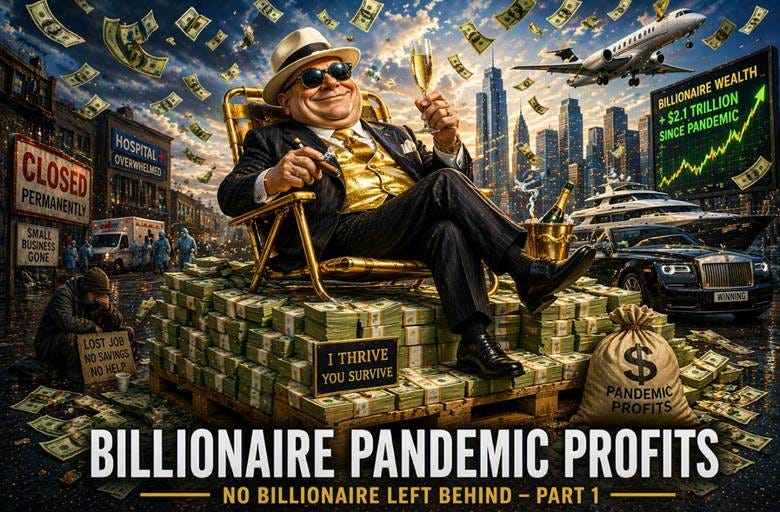
While millions of Americans lost jobs, homes, and loved ones to COVID-19, America’s billionaires got $1.7 trillion richer.
The pandemic struck with layoffs, business closures, housing uncertainty, and a public health crisis unlike anything seen in generations. Families depleted their savings, food-bank lines stretched for blocks, and essential workers continued to report for duty under extraordinary circumstances.
Economists often describe the pandemic economy as “K-shaped.” Rather than lifting all groups equally, the recovery split in different directions. Higher-income households and those with significant stock and asset holdings generally saw wealth increase, while many lower-wage workers, small businesses, and financially vulnerable households faced a slower and more difficult recovery. The diverging paths resembled the two arms of the letter “K.”
Two arms. Two Americas.
The result was a recovery that rewarded those already positioned to benefit while leaving many others struggling to catch up or even survive.
Federal Reserve data show that the wealthiest 10% of Americans now own roughly two-thirds of all U.S. household wealth, while the bottom 90% own about one-third.
This first installment of the No Billionaire Left Behind series examines one of the most striking examples of that divide: the extraordinary gains amassed by America’s billionaires during a period when much of the country was confronting economic hardship, illness, and uncertainty. At its heart, this story is about more than wealth.
It is about responsibility. When a nation faces a crisis, many believe that those who have benefited the most from its economic system should be expected to contribute more to the common good. The pandemic provides a unique opportunity to examine that question.
The $1.7 Trillion Question
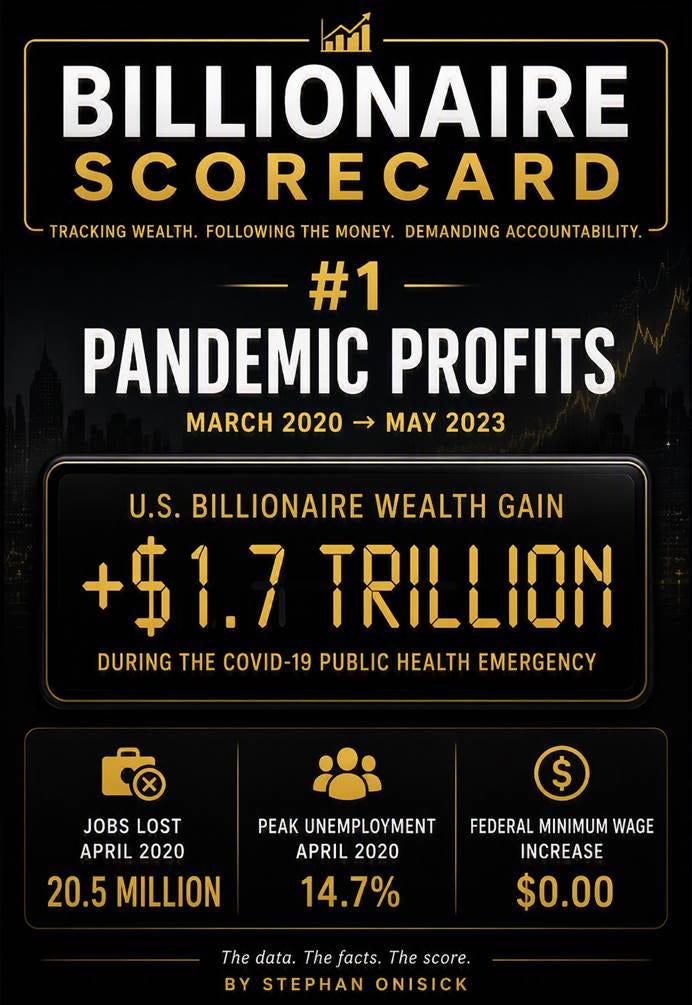
The pandemic affected Americans very differently depending on where they sat in the economy. Millions of workers experienced layoffs, furloughs, business closures, and financial uncertainty. In April 2020 alone, the United States lost 20.5 million jobs, and unemployment surged to 14.7 percent—the highest level since the Great Depression era.
At the same time, asset owners benefited from a powerful recovery in stock prices, rising corporate valuations, and unprecedented market gains. By the end of the federally declared COVID-19 public health emergency, America’s billionaires had increased their collective wealth by approximately $1.7 trillion compared with the beginning of the crisis.
The contrast is not offered as an argument against success or wealth creation. Rather, it illustrates the unequal impact of a national emergency. While millions faced job losses and economic hardship, the federal minimum wage remained frozen at $7.25 per hour throughout the entire period.
The numbers below tell the story more clearly than rhetoric ever could.
Conclusion
The pandemic did not create America’s wealth divide, but it exposed it. During one of the most difficult periods in modern history, millions struggled to maintain jobs, housing, and financial security while billionaires’ wealth surged by approximately $1.7 trillion. Whether that outcome reflects a healthy economic system—or one in need of reform—is a question worth asking.
To be fair, not every billionaire treated the pandemic solely as a wealth-building opportunity. Individuals such as MacKenzie Scott, Jack Dorsey, Bill and Melinda Gates, and Michael Bloomberg directed significant sums toward public health, vaccine development, food insecurity, and community relief efforts.
Their actions demonstrated that extraordinary wealth can be deployed quickly during a national emergency. But look at where that wealth stands today. Scott has given away more than $19 billion since 2019, and her net worth has still climbed back above where she started. Bloomberg has donated more than $21 billion, yet his fortune has more than doubled since 2020. Gates and Dorsey show the same pattern: years of large-scale giving, and a balance sheet that recovers anyway. The question raised by critics is not whether some billionaires gave generously. It’s whether voluntary philanthropy can ever outpace a system in which capital gains regenerate wealth faster than it can be given away.
Don’t you wish you had that problem?
Also, given the magnitude of their largess, was there a proportional response to what they have received or taken from the American economy?
In my view, the answer is no.
Stephan
Part 2 looks at the Giving Pledge — who signed it, what it actually commits them to, and whether it holds up under scrutiny.
Follow along, and tell me in the comments: is voluntary philanthropy enough, or is it time to rethink the system itself?
Sources
Introduction
· BLS.gov - The K-Shaped Recovery: - Jul 1, 2021
· Federal Reserve - DFA: Distributional Financial Accounts - Ongoing dataset
Pandemic Profits
· U.s. Bureau of Labor Statistics - Employment Situation News Release 2020-05-08 - May 8, 2020
· U.s. Bureau of Labor Statistics -TED: The Economics Day - April 1 2020 - Apr 1, 2020
· Institute for Policy Studies (IPS) - US Deaths from COVID-19 March 2022 - May 4, 2022
Conclusion
· Forbes - America’s Top Givers - The 25 Most Philantropic Billionaires - Jan 19, 2021
· Purpose_Brand - How the Wealthiest Fight COVID-19 - Apr 2020 (approx.)
· Fortune / Moneywise - MacKenzie Scott’s Wealth Outpaces Her Donations - Nov 7, 2025
· Forbes / Celebrity Net Worth - Bill Gates Net Worth - Jul 13, 2026 (approx.)
· Forbes Profile / Datawallet - Jack Dorsey Net Worth - Jun 9, 2026