You've Got Anthem Now Try Using It

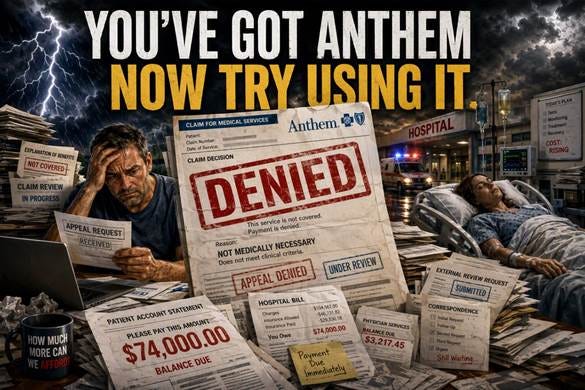
We have a piece of paper that feels like insurance until the moment we actually need it.
This article reflects my own views with assistance from AI in drafting, presentation, research, and rephrasing.
Introduction
Americans spend thousands of dollars each year on health insurance for one reason: protection. They accept rising premiums, deductibles, copays, and out-of-pocket costs with the expectation that when a serious medical event occurs, their insurance coverage will help shield them from financial devastation.
What many people do not realize is how often claims are denied.
Recent data shows that claim denials are widespread across the health insurance industry, not just an occasional inconvenience. Commercial insurance plans denied roughly 14% of claims in 2022 and 2023, while insurers on the ACA marketplace denied about 20%, with out-of-network claims denied at more than double that rate.
Some insurers denied far more than the average. Blue Cross Blue Shield of Alabama, the same insurer that would go on to deny my wife’s hospital stay, posted one of the highest denial rates in the country, rejecting roughly a third of all claims.
That figure reflects marketplace plans specifically; denial data for employer-sponsored self-funded plans like mine is not publicly reported in the same way. But it speaks to the same insurer’s broader pattern of denying claims at a high rate. These are not isolated incidents or statistical anomalies.
They represent millions of claims affecting millions of insured Americans, and they show a pattern that starts well before any individual case is ever filed. The common perception is that claim denials happen only when patients seek unnecessary care, fail to follow insurance rules, or attempt to obtain services excluded by their policy.
In reality, claim denials have become a routine feature of the healthcare system. Administrative issues, authorization requirements, coverage disputes, and disagreements over medical necessity can all result in benefits being withheld after care has already been provided.
As a result, every insured person is potentially at risk. A hospitalization, emergency room visit, specialist referral, diagnostic test, or unexpected illness can suddenly trigger a review process that many consumers never knew existed. The assumption that possessing health insurance guarantees payment of medical claims is increasingly at odds with the reality experienced by many patients and families.
This should concern anyone who carries a health insurance card. The issue is not whether claim denials occur. The evidence shows they occur every day. The real question is whether consumers understand how frequently they happen, and whether they are prepared when a denial arrives.
My Case
I’ve worked at IBM for 6 years. Anthem was my primary insurance, and Medicare was my secondary.
On Oct 3,2025 my wife suddenly lost consciousness. Between the 911 responders and ambulance service, she was rushed to the Crestwood Hospital ER in Huntsville.
Tests showed she was COVID-positive, and given her history of two strokes and anti-seizure meds, the ER doctor admitted her for further evaluation.
Weeks later, Anthem denied the hospital stay, claiming there were “no cofactors” and she should’ve been sent home.
The Explanation of Benefits? Over $74,000 for two days.
Did I admit her?
Am I supposed to diagnose my wife, consult with Anthem, and refuse her admission, all this while her life was in jeopardy?
I was a programmer, not a doctor.
In January, due to the hospital’s delay in submitting an appeal, I elected to file one myself on my wife’s behalf. The instructions on the Anthem website were minimal, and the appeal form itself was quite basic.
No guidance was provided on submitting medical records. I believed Anthem would have access to her prior hospitalization history, including two major strokes the previous year caused by a brain hemorrhage that required more than a month of inpatient care, and a month of rehabilitation care.
We received a reply on February 20, 2026, denying our claim as “Not Medically Necessary.”
Well, almost nine months after her 10/3/2025 hospital stay, Crestwood has said several times that they have submitted the internal appeal, but Blue Cross has never received it.
I am struggling to resolve this.
Should an individual employed by IBM and covered by Anthem for almost six years be required to worry about an admission over which he had no control?
IBM’s health plan is self-funded, with Anthem acting as the administrator. Given that, I’ve sent a letter directly to the IBM Plan Administrator. When I receive a reply, I will update this article with the letter and their response.
The Runaround
What followed my wife’s hospitalization wasn’t a single denial and a single appeal. It was nine months of phone calls, conflicting stories, and paperwork that seemingly vanished into thin air.
Anthem issued its first denial less than a month after she was discharged, calling a two-day hospital stay for a COVID-positive stroke patient “not medically necessary.”
When I filed my own appeal in January, I assumed Crestwood was also working the case on their end, since that’s what a hospital’s billing and appeals department is supposed to do.
What I didn’t know was that Crestwood’s appeal, submitted back in December, had been mailed to the wrong P.O. Box. Not my mistake. Not Anthem’s mistake, as far as I can tell. Just an address error that cost us months.
From there, it became a pattern. I’d get an update: an appeal was “being worked on,” an appeal was “escalated,” an appeal would need “additional time,” and then nothing would change.
Every few weeks, a different Crestwood representative would tell my Anthem health advocate, Michael Lawrence, something slightly different from what the last one said. By June, Crestwood finally confirmed they’d resubmitted the appeal to the correct address. By late July, Anthem said they had no record of ever receiving it.
Nine months in, I still don’t have a resolved claim, a clear answer, or the medical records my Anthem health advocate requested back in May. What I have is a stack of phone logs and an unresolved balance still sitting on my account.
Below is the full timeline, as documented through my Anthem health advocate’s contact log.
Timeline of Claim, Appeals, and Follow-Up Activity
Date
Event
October 3, 2025
Wife admitted to Crestwood Hospital, Huntsville, AL, after loss of consciousness and a positive COVID-19 diagnosis.
October 30, 2025
Anthem issues initial denial, stating the inpatient admission was not medically necessary.
November 7, 2025
Anthem Health Advocate Michael Lawrence contacts Crestwood; hospital says supporting documentation will be submitted.
December 18, 2025
Lawrence speaks with Tonya at Crestwood; she says an appeal is forthcoming.
December 30, 2025
Lawrence speaks with Nadia at Crestwood’s corporate office; she says an appeal was faxed to Blue Cross Blue Shield of Alabama on December 19.
Jan 2026
I submit my own appeal directly to Anthem.
February 5, 2026
Lawrence speaks with Tony at Crestwood; he says the December 19 appeal was mailed to the wrong P.O. Box.
February 20, 2026
Anthem denies my appeal, upholding the “not medically necessary” determination.
February 20, 2026
Lawrence speaks with Ashley at Crestwood; she says the hospital’s appeal is still being worked on.
March 23, 2026
Lawrence speaks with Asia at Crestwood; she says she will escalate the claim.
April 30, 2026
Lawrence speaks with Yeskeka at Crestwood; she says more time is needed.
May 12, 2026
Lawrence requests my wife’s medical records from Crestwood, planning to assist with a further appeal once received.
June 11, 2026
Joint call with Lawrence, me, and Tiara at Crestwood; Tiara confirms an appeal was submitted that day to the correct address.
Jul 22, 2026
Lawrence reports Anthem has no record of receiving any additional appeal. The medical records requested in May still haven’t arrived.
Nine months. Twelve different names. A claim that’s no closer to resolved than it was in October.
Are we really insured?
This isn’t just my problem. It’s a fundamental failure of a system designed to protect us in our most vulnerable moments. An insurance company decided, from behind a desk, armed only with denial language, that my wife’s life-threatening medical emergency wasn’t worth treating.
And I’m expected to navigate their bureaucracy, spend months fighting for coverage I paid for, and face a denied amount of over $74,000 for having the audacity to choose her life.
If you’ve faced something similar, you already know the answer to “Are we really insured?” No.
We have a piece of paper that feels like insurance until the moment we actually need it.
Then it becomes a legal document designed to deny us coverage on technicalities while we worry about whether our loved ones will survive.
This needs to change. Now.
If you’ve been through something like this, I want to hear it.
Comment below and share your story.
The more of us who say this out loud, the harder it is for insurers to pretend these are isolated cases.
Thanks for reading Thinking Human, Building AI! Subscribe for free to receive new posts and support my work.