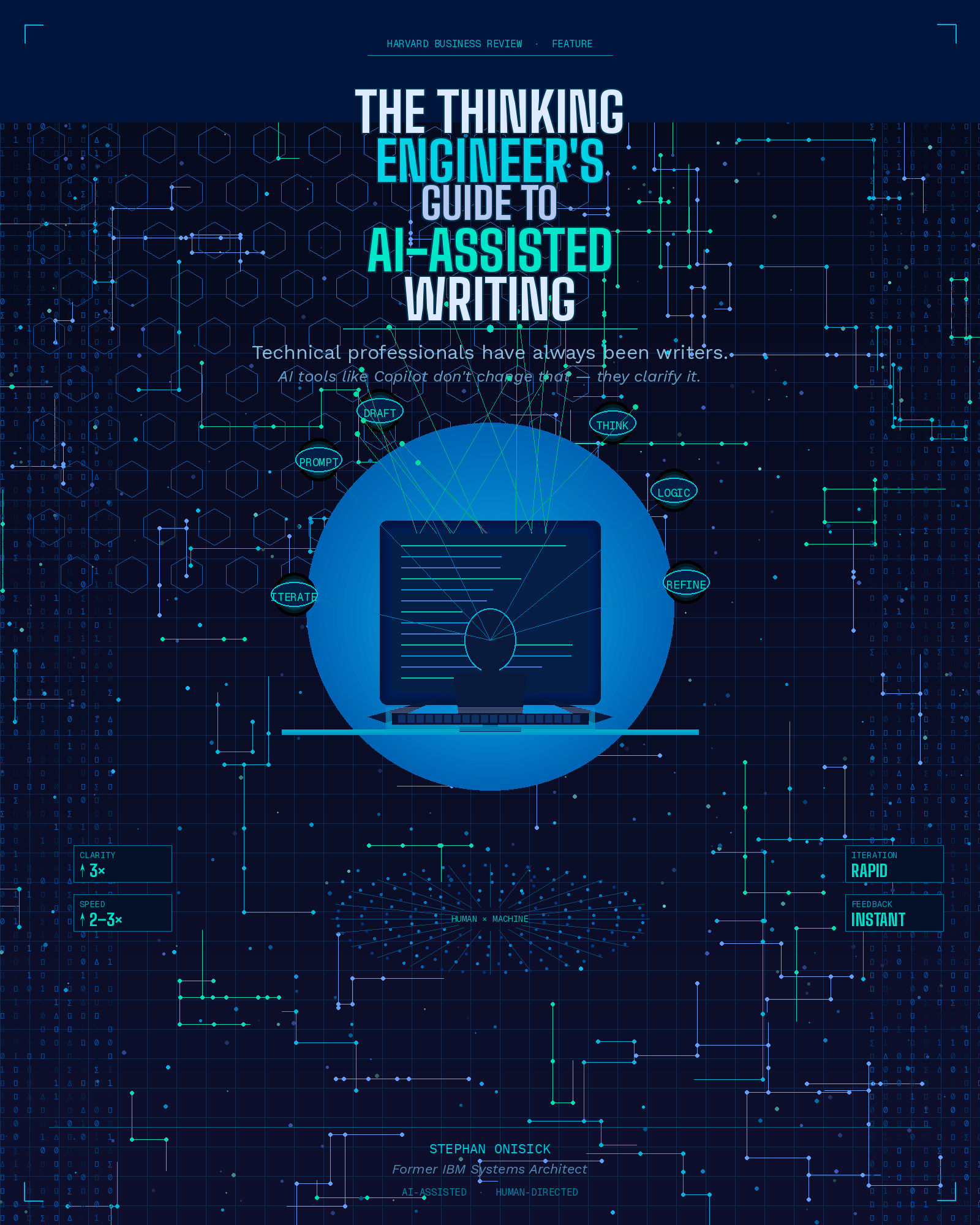
The Thinking Engineer's Guide to AI-Assisted Writing

Technical professionals have always been writers. AI tools like Copilot don’t change that — they clarify it.
Stephan Onisick
Former IBM Managing Consultant
Disclosure: Microsoft Copilot assisted with drafting and presentation of this article.
For most of my career, I didn’t think of myself as a writer. I was a systems architect at IBM. I built things, designed them, and then — inevitably — explained them. I wrote design notes, operations guides, stakeholder emails, and the occasional post-mortem. None of it felt like writing in any meaningful sense. It was just part of the job.
Only in retrospect did I recognize what should have been obvious all along: I had been writing. And if you have spent a career in engineering, software development, or technical management, so have you.
The rise of AI writing tools — Microsoft Copilot, in my case — hasn’t changed that fundamental truth. What has changed is how visible and approachable the process has become. Used correctly, Copilot is not a ghostwriter. It is a thinking partner: one that accelerates iteration, surfaces weaknesses in reasoning, and helps technical professionals communicate with the clarity their ideas deserve.
That distinction matters enormously — and most of the existing conversation about AI writing tools misses it entirely.
Copilot doesn’t replace judgment — it demands it.
Technical Professionals Are Already Writers
The word “writer” carries cultural baggage. It conjures novelists, journalists, and academics. Engineers rarely claim the label. But consider what technical work actually requires.
Engineers explain why a design choice was made, sometimes in a one-line commit message and sometimes in a ten-page architecture review. They document edge cases that future colleagues will depend on. They write instructions precise enough that a minor wording error results in a production incident. They send emails that move projects forward or derail them.
This kind of writing is often harder than an essay. Precision matters. Ambiguity has consequences. Clarity is not a stylistic preference — it is a functional requirement.
And yet most engineers receive no training in it, no feedback loop for it, and no language to describe what they are doing when they do it well. The result is a vast population of professionals who write constantly, communicate effectively when they focus on it, and still believe, somehow, that writing is someone else’s domain.
AI tools are beginning to correct that misperception — not by writing for us, but by making the invisible process of writing visible enough to engage with deliberately.
Why the Engineering Mindset Is an Asset Here
The standard narrative about AI writing tools positions them as productivity accelerators: you put in a rough draft and get polished prose. That framing attracts a certain kind of user and produces a certain kind of output — generic, fast, forgettable.
In my experience, technical professionals approach these tools differently. And that difference is a genuine strategic advantage.
Engineers think iteratively. We try something, inspect the output, identify what is wrong with it, and revise. We do not expect the first version to be correct — we expect it to be inspectable. That is precisely how AI writing tools work best, and it is a workflow most engineers already understand intuitively.
When I use Copilot, I do not ask it to write my article. I ask it to expand a rough idea, propose alternative phrasings for a section I know is unclear, critique a draft for logical gaps, or generate test cases for an argument I want to stress-test. Then I evaluate the output the way I would review a pull request: some suggestions are useful, some are wrong, and some point toward a better idea than either of us had independently.
Copilot is not an authority. It is more like a junior collaborator who works fast, never gets tired, and doesn’t mind being corrected.
For engineers accustomed to working with systems that do exactly what they are told, Copilot’s occasional wrongness is not a bug — it is part of the workflow. The discipline of evaluating output rather than accepting it is exactly what makes these tools powerful in technically minded hands.
A Concrete Example
Let me be specific about what this looks like in practice. When I was developing a piece on AI content labeling, I started with a few rough ideas — not a draft, just fragments:
Prompt submitted to Copilot:
Generate a punchy opening paragraph for the following topic:
I want to write about why clear labeling of AI-generated images,
videos, and documents is essential.
— Improperly labeled AI blurs the line between real and synthesized.
— Ambiguity can mislead and result in poor decisions.
— Especially harmful in political settings.
One response Copilot returned:
AI doesn’t just create content — it creates plausible reality. When
AI-generated images, videos, and documents are left unlabeled,
and audiences are asked to trust what they’re seeing without knowing it
was synthesized. That’s not a technical oversight; it’s a failure of
responsibility. In political contexts, this ambiguity can especially
mislead voters, provoke unwarranted reactions, and lead to decisions
based on illusions rather than facts.
I did not use that paragraph verbatim. But reacting to it — deciding what it got right, what it flattened, what it missed — sharpened my own thinking considerably. That is the actual value. Not the paragraph. The reaction to it.
This is a mode of engagement that technical professionals are already trained for. We evaluate systems for correctness, not just for output. Applying that discipline to writing is a natural extension of a skill set most engineers already possess.
The Real Benefit Is Clarity, Not Speed
Discussions of AI productivity tools focus heavily on speed. I write faster with Copilot — by my informal estimate, two to three times faster. But speed is a secondary benefit, and treating it as the primary one leads organizations to deploy these tools in ways that undermine the thinking they should be supporting.
The deeper benefit is clarity. Writing has always been a thinking tool: the act of explaining an idea forces you to understand it more precisely than you thought you did. But that process used to be slow and often frustrating. Stuck on a paragraph that wasn’t working, I would reread the same sentences repeatedly, sensing a problem I could not locate.
Copilot breaks that stall. Generating alternatives quickly gives me something to compare against. Weaknesses that were invisible in a single draft become obvious when set beside a different version of the same idea. I can see what is missing, what is imprecise, and what is buried when it should be leading.
For organizations deploying AI writing tools at scale, this is the framing that matters. The goal is not to accelerate output. The goal is to raise the quality of thinking that the output represents.
Feedback Without the Ego Cost
There is a second benefit that rarely appears in productivity discussions: AI tools change the emotional dynamics of receiving feedback.
Most professionals avoid feedback on their writing because it feels personal. The alternative — not seeking feedback — leaves problems unaddressed until they reach an audience. Neither outcome is good.
When I ask Copilot to critique a draft, it identifies gaps, weak transitions, and sections that lack weight. It does this structurally and without ego. I do not need to wait for an editor. I do not need to guess how a reader will react. I get a second perspective early, when changes are still easy.
That does not mean I accept its suggestions. Copilot is a starting point for evaluation, not a conclusion. But having immediate, usable feedback changes the writing process in ways that matter practically. It removes the bottleneck of the editorial relationship and moves the quality check earlier in the process.
For organizations with technical teams that produce significant amounts of written communication — documentation, strategy memos, client-facing reports — this is worth taking seriously. The barrier to high-quality written output is rarely knowledge or intelligence. It is usually due to friction in the feedback loop.
What This Means for Technical Leaders
The professionals most likely to benefit from AI writing tools are also the ones least likely to think they need them. Engineers and technical managers who communicate ideas for a living — who write to explain, not to express — have historically received the least support for that part of their work.
AI tools close that gap, but only if they are used in a way that preserves judgment rather than replacing it. That means treating AI output as a draft to be evaluated, not a document to be approved. It means using iteration, not delegation. It means staying engaged with the output, challenging it, and improving it — the way you would engage with any system you are responsible for.
The professionals who will get the most out of these tools are the ones who bring the rigor they apply to technical problems to the process of communication. That is not a new skill. It is the application of an existing one.
Conclusion
After retiring from IBM, I no longer write because I have to. I write because I find it useful — to think more clearly, to communicate more precisely, and to share perspectives that I spent a long career developing.
Copilot made that transition easier than I expected. Not because it writes for me, but because it removed the friction that had always made starting the hardest part. It gave me something to react to, something to improve, something to push against.
That is, it turns out, exactly what good technical collaboration feels like.
For engineers, developers, and technical leaders who have always communicated for a living without quite calling it writing, the tools have finally caught up with the work you were already doing. The question now is whether you will use them in a way that raises the quality of your thinking — or simply the volume of your output.
The choice, as always, belongs to the human.
About the Author
Stephan Onisick is a retired IBM systems architect with decades of experience designing and explaining complex technical systems. This article reflects his own ideas; Microsoft Copilot assisted with drafting and presentation.