
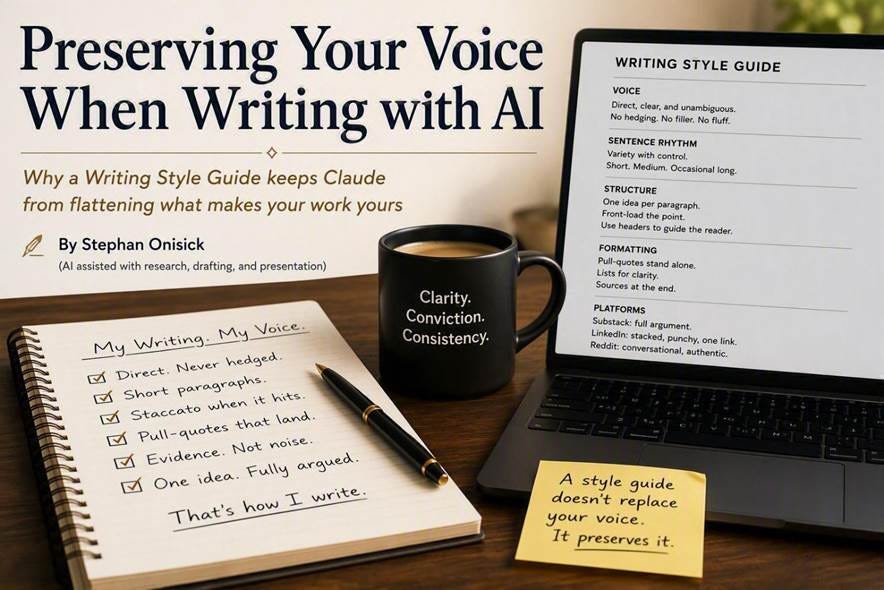
(AI assisted with research, drafting, rephrasing, and presentation)
“A style guide doesn’t replace your voice. It preserves it.”
I want to write basically the same way every time, but I want to allow for improvements and new patterns if I find them. The problem was never my voice. The problem was explaining it — over and over, to a tool with no memory of the last conversation.
The Blank Page Problem
Every time I opened a new conversation with Claude, I started from zero. I’d paste in a draft, get something competent back, and feel the sting of recognition: this wasn’t wrong, exactly. It just wasn’t mine. The sentence rhythm was off. The hedging crept in where I never hedge. The structure read like a report instead of a case being built.
I didn’t need a smarter AI. I needed a way to hand it my voice once, permanently, instead of re-teaching it every session.
That’s what a Writing Style Guide is. Not a style sheet of fonts and margins — though it has those too. A codified record of how you actually write: your sentence rhythm, your argumentative instincts, your formatting habits, the small things you do without thinking that a reader would notice if they were suddenly gone.
The guide doesn’t say use short paragraphs. It says: “Paragraphs run one to two sentences, occasionally three if they’re short; one sentence alone if it’s a long one.”
I had another reason to build one. I don’t just write for Substack. I take those same pieces and adapt them for LinkedIn — shorter, punchier, built for a feed instead of a page. A generic “make this shorter for LinkedIn” prompt doesn’t know that. It doesn’t know I want stacked short lines, or that my pull-quotes get duplicated rather than pulled, or that I close every LinkedIn post with exactly one link back to the full piece. Without a guide, I was negotiating those same decisions every single time.
Building the First Draft
I didn’t sit down and write the guide from scratch. I reverse-engineered it.
I gathered three or four pieces I already trusted — work I’d stand behind as mine — and handed them to Claude together, not one at a time. I asked it to find what repeated across all of them, not what was unique to any single piece. A quirk in one essay is a tic. A quirk in four is a pattern.
I asked for specifics, not impressions. Not “sounds direct” — which sentence, and which word, made it direct instead of hedged. Not “uses short paragraphs” — how short, and when do they break into something longer?
Some rules need an example to mean anything. Mine has one for the staccato technique: “Protection.” / “That is the pattern.” / “Two arms. Two Americas.” — three lines that show the move instead of naming it.
The guide will keep getting updates as long as you keep asking Claude to create something new or different and to update the guide to reflect this.
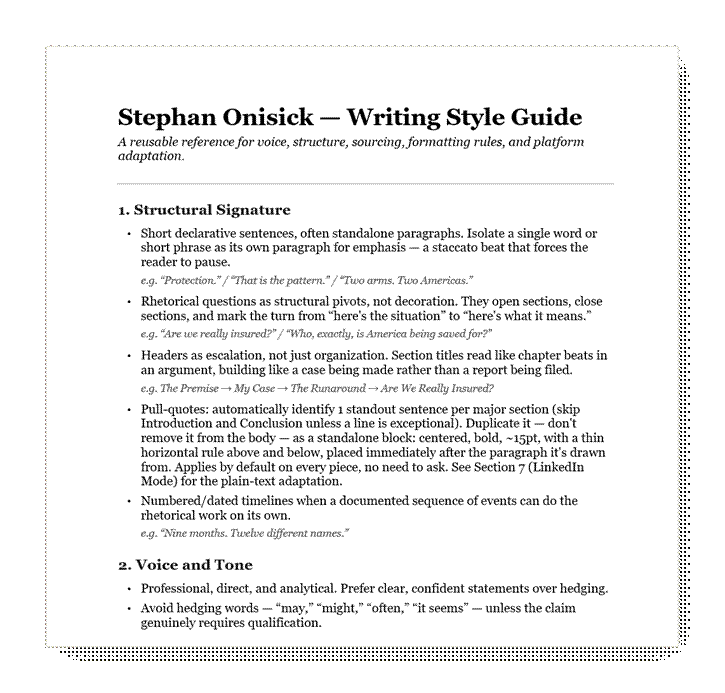
Figure 1. Start of Writing Style Guide
One Voice, Different Venues
You have one voice. You have several venues. Each one has its own rules for what a reader expects — and once you check them, the emphasis has to shift with the audience.
For me, Substack gets the full argument — paragraphs, headers, a sourced closing section. LinkedIn gets the same idea, compressed into stacked lines built for a feed that truncates after two lines, and no source references. Reddit gets something looser still, closer to how I’d actually explain myself to another person, not perform for an audience.
The guide lets me build a LinkedIn article straight from a Substack piece. I hand Claude three things: the guide, the article, and a link back to the Substack piece — because I want readers to know a fuller version exists, with the sources I actually used.
I didn’t describe these differences to Claude in the abstract. I showed it pairs — a Substack piece next to how I’d actually want it adapted for LinkedIn — and asked it to find the transformation, not just the destination. That’s the difference between a guide that says “be punchier on LinkedIn” and one that says exactly how punchy, and where.
It took trial and error to get here, and it still isn’t automatic. I read the LinkedIn version aloud to check it sounds like me. Sometimes I edit it further. But most of the work is already done by the time I get to that step.
On Substack, a pull-quote is centered, bold, boxed in rules. On LinkedIn, the same instruction becomes: “skip borders and font size — instead, give the line its own stacked block, set off with a blank line above and below.” Same idea. Different room.
A Living Document
The guide I use today isn’t the one I started with. It has a line in it, timestamped, from the day I decided every LinkedIn post needed a hero image by default — added the moment I made that decision, not months later when I’d forgotten why.
The entry reads: “Added per your request on 7/30/2026, revised 7/30/2026 (twice) — no prior guidance existed for graphics on LinkedIn.” That’s not a stylistic flourish. That’s the guide keeping its own receipts.
That’s the habit that matters most. The guide isn’t a reference you write once and consult forever. It’s alive, the same as the writing it protects. When I make a real decision in a real piece — a formatting call, a rule I didn’t have before — I tell Claude to fold it into the guide immediately. Not “someday.” That day.
“The guide isn’t finished. It’s alive, the same as the writing it protects.”
What to Say — and What to Avoid
The guide only works if the instructions inside it are as specific as the voice it’s protecting. “No hedging” is vague. “Avoid ‘may,’ ‘might,’ ‘often,’ unless the claim genuinely requires it” is usable. Where a rule is hard to state abstractly, I give an example instead — a weak header next to the sharpened version it became.
The failure mode is drift in either direction. Make the guide too generic, and it stops protecting anything distinctive. Let it go stale, and you’re back to re-explaining yourself piece by piece. The fix for both is the same: keep feeding it real decisions from real pieces, not hypothetical rules you think you might want someday.
The Payoff
I don’t argue with Claude about my own voice anymore. I don’t re-explain why I don’t use bracketed citations, or why a pull-quote gets duplicated instead of removed, or why LinkedIn gets one link, and Substack gets a sourced list. That conversation already happened. It's written down.
You don’t lose your voice to AI. You lose it to inconsistency — a hundred small negotiations, each one slightly different, until nothing sounds quite like you anymore. A style guide is how you stop having that argument every time.
Start small. Three pieces you trust. One prompt. Build from there.
— Stephan