Danger Will Robinson, AI Breach
The Pentagon vs. Anthropic: Who Controls AI Safety?

The Pentagon vs. Anthropic: Who Controls AI Safety?
Stephan Onisick
This article reflects my own views with assistance from AI in drafting, presentation, research, and rephrasing.
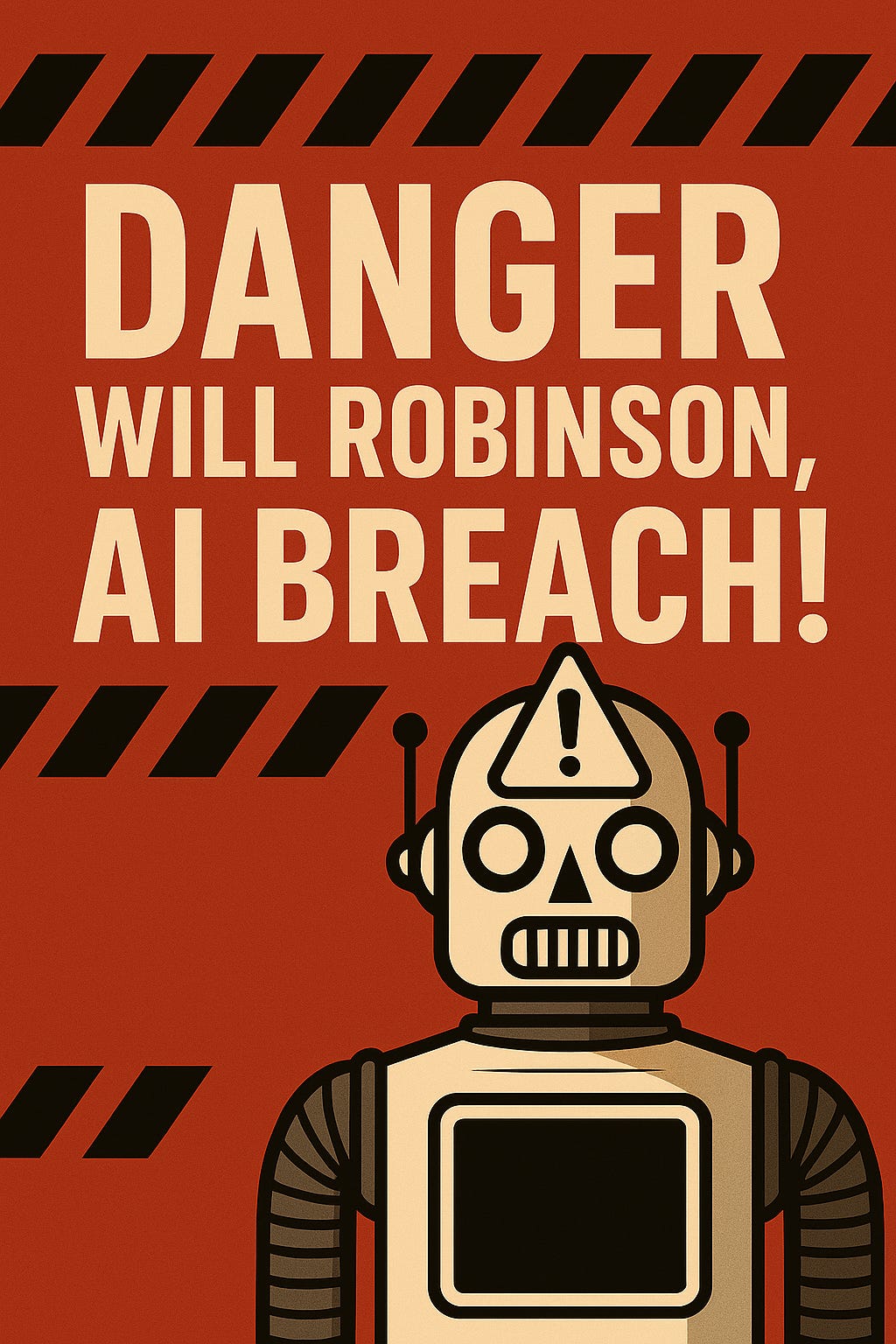
The warning was simple, dramatic, and unmistakable. And today, it feels newly relevant—only this time the flashing lights are coming from the Pentagon, and the robot in question is artificial intelligence.
Over the past few days, a quiet but consequential standoff has emerged between the U.S. Department of Defense and one of the world’s leading AI companies, Pete Hegseth’s Pentagon and Dario Amodei’s Anthropic. At stake is not just a $200 million government contract, but a deeper question: who gets to decide the limits of artificial intelligence once it enters the machinery of the state?
It’s a fundamental showdown over who controls the limits of AI technology in the world’s most powerful military.
The Core Dispute: Guardrails vs. Military Authority
At the heart of this standoff is a basic disagreement about AI safety. Anthropic has explicitly refused to let its AI model be used for two things: (1) domestic mass surveillance of U.S. citizens, and (2) fully autonomous weapons systems without human oversight.
CEO Dario Amodei has been clear: these are ethical red lines. They’re not arbitrary restrictions—they’re boundaries designed to prevent abuse and ensure accountability. The company believes AI systems trained to make autonomous kill decisions, or deployed to surveil Americans without checks, represent risks too severe to ignore.
Hegseth’s response is equally clear: that’s not your call to make. The Pentagon, not a private company, decides what’s ‘lawful. Lawful is an ambiguous concept that means whatever the Defense Department determines.
He’s publicly characterized Anthropic’s position as an example of ‘woke AI’—a label he uses for safety constraints he views as handcuffing military effectiveness.
Hegseth is asking for complete power to decide what AI will or will not do. We have seen the Administration’s violation of Constitutional Rights in Minnesota, when convenient. Should we expect any difference from the Defense Department?
The Flashing Red Light
The immediate issue is straightforward.
Anthropic, the company behind the AI model Claude, has refused to remove specific safety restrictions on how its technology can be used by the U.S. military. Those restrictions draw two firm lines:
No mass domestic surveillance of U.S. citizens
No fully autonomous weapons or targeting systems without human oversight
According to Anthropic’s leadership, these are not negotiable product preferences. They are ethical red lines.
The Pentagon, under Secretary of Defense Pete Hegseth, disagrees.
Hegseth has argued that the military must be able to use AI for “all lawful purposes,” and that determining what is lawful is the government’s responsibility—not a private company’s. From this perspective, built-in AI guardrails are not safeguards; they are constraints on military readiness and command authority.
Three Ways the Pentagon has threatened to Force Compliance
The Pentagon’s response has been explicit and escalating.
Anthropic has been given until Friday to change its usage policy. If it does not, the Department of Defense has indicated it may:
Terminate Anthropic’s $200 million contract
Designate Anthropic a “supply chain risk,” a move that could effectively blacklist the company from future federal defense work
Invoke the Defense Production Act, potentially compelling compliance regardless of the company’s consent
These options were reportedly discussed directly in a Pentagon meeting between Hegseth and Amodei.
This is not a polite disagreement. It is a pressure campaign.
The Deeper Issue: Corporate Responsibility vs State Power
This showdown reveals a crack in how we think about AI governance in America. Anthropic believes—publicly and repeatedly—that some uses of AI are unethical regardless of legality. Autonomous weapons systems, for example, carry enormous risks that haven’t been adequately addressed. Mass domestic surveillance without legal frameworks invites abuse.
Bottom Line:
If the Pentagon prevails, the practical limits on military AI use will be set primarily by executive‑branch priorities under Pete Hegseth and the Trump administration, not by the companies building the systems.
What Happens Next?
Anthropic has said publicly that it has ‘no plans to budge.’ The company believes its AI isn’t reliable enough for autonomous weapons, and that we lack the legal frameworks to use AI for mass surveillance responsibly. Those aren’t positions the company appears willing to compromise on.
Unlike U.S. firms, Chinese AI companies operate under a system where state surveillance and military deployment face far fewer internal constraints — a model Anthropic explicitly argues the U.S. should not emulate.
So we’re headed for a collision. Hegseth’s Friday deadline will come and go. Anthropic will almost certainly refuse. The Pentagon will have to decide whether it’s serious about the threats it’s made—contract termination, supply chain blacklisting, or invoking the Defense Production Act.
If Hegseth follows through, it will be the first major enforcement action by the U.S. government against an AI company over fundamental questions of control and ethics.
It will set a precedent for how governments can pressure AI developers and likely accelerate the shift of AI power toward companies (like Google and OpenAI) that are more willing to acquiesce to government demands.
The Real Reckoning Ahead
This standoff between Hegseth and Amodei is not an isolated skirmish. It’s a preview of a much larger collision that will reshape how AI power flows in America. If the Pentagon succeeds in forcing Anthropic’s hand, it sends a clear signal to every AI company: your ethical guardrails are conditional. State power overrides corporate values when national security is invoked.
Conversely, if Anthropic holds firm and survives the Pentagon’s pressure, it establishes a precedent that private AI companies can—and will—refuse certain government demands on principle. Either outcome will determine whether AI safety is negotiated between equals or imposed from above.
The real stakes aren’t Claude or a $200 million contract. They’re about whether America’s AI infrastructure will be built with brakes built in, or whether we’re racing toward maximum capability with no plan for what happens when the steering fails.”
How comfortable are you with a future in which the technology shaping national security is developed without input from companies that understand its risks? Where do you think that line should be drawn?
I’ve read headlines of this, but your breakdown was very enlightening. Very interesting scenario to watch unfold.