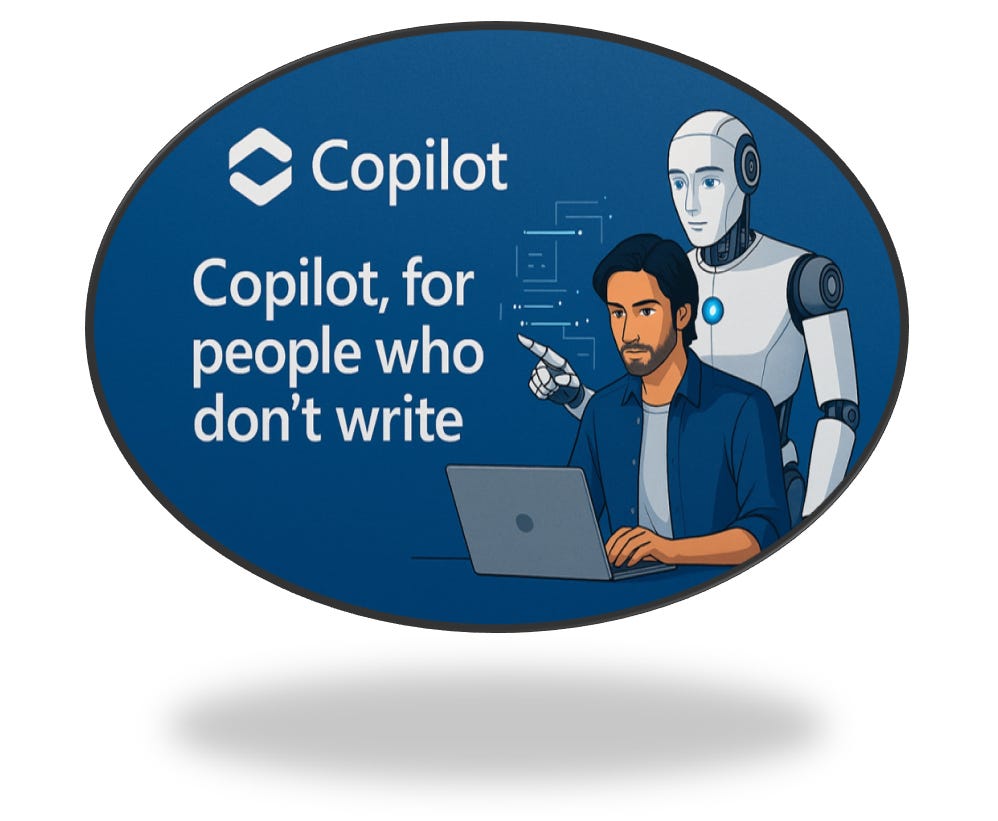
Copilot, for people who don’t write

Stephan Onisick
“This article reflects my own ideas; Microsoft Copilot assisted with drafting and presentation.”
Intro
(Developers, Engineers, Makers, Retirees)
Most people don’t think of themselves as writers. Developers, engineers, makers—we tend to reserve that word for novelists, journalists, or academics. But if you’ve ever tried to explain how something works, you’ve already been writing.
For most of my career, I built computer systems that required extensive coding—and then I explained them. I wrote documentation and design notes, operations guides and user manuals, emails to stakeholders and superiors, and the occasional review summarizing my work.
I taught others how the systems worked and tried to be clear enough to prevent misunderstandings and mistakes. At the time, none of it felt like “writing” in any meaningful sense. It was just part of the job. Only later did I recognize what seems obvious now: I had been writing all along.
A couple of things have changed. One is the technology—AI, specifically. Tools like Microsoft’s Copilot give me quick summaries, help tighten up my own thinking, and offer instant, grammatically clean rephrasing.
The other change was more personal. After retiring from IBM last year, I no longer write because I have to. I write to communicate from my own perspective. Writing clearly helps me understand ideas more fully and makes it easier for my audience to follow my thinking.
That’s where Copilot came in—not as a ghostwriter, but as a surprisingly helpful partner for someone like me who never set out to be a writer in the first place.
Engineers and Makers Already Write (They Don’t Call It That)
If you’ve spent a career building things, you’ve probably written more than you think.
You’ve explained why a design choice was made. You’ve documented edge cases. You’ve written instructions that had to be followed precisely. You’ve answered the same question for the fifth time and finally wrote it down so you wouldn’t have to answer it again.
That kind of writing is often harder than essays or blog posts. Precision matters. Ambiguity has consequences. You don’t get credit for sounding clever—you get credit for being clear.
This is why Copilot fits engineers, makers, and technical thinkers so naturally. It doesn’t ask you to become expressive or lyrical. It helps you become clearer, faster, and more deliberate about things you already know.
Copilot doesn’t turn you into a writer. It removes friction from communication you were already doing.
Why Copilot Fits Technical Minds
Engineers think iteratively. We try something, inspect it, refine it, and repeat. We don’t expect the first version to be perfect—we expect it to be inspectable.
That’s exactly how Copilot works best.
I don’t ask Copilot to “write my article.” I ask it to expand a rough idea, offer alternative phrasings, critique a draft, or suggest a clearer structure. I might also ask it to analyze a block of code, summarize a report, sanity‑check a conclusion, or generate test data so I can explore an edge case more quickly.
Then I evaluate the output the same way I’d review a pull request. Some suggestions are useful. Some are wrong. Some spark a better idea than either of us had alone.
Copilot doesn’t replace judgment—it demands it.
For technical people, this feels familiar. Copilot isn’t an authority. It’s more like a junior collaborator who works fast, never gets tired, and doesn’t mind being corrected.
Let me illustrate with a simple example:
Copilot, generate me a punchy opening paragraph for the following topic:
I want to write a piece about why clear labeling of AI-generated images, videos, and documents is essential.
·Improperly labeled AI blurs the line between what is real and what is synthesized.
Ambiguity can mislead audiences and result in unwarranted actions or poor decisions.
Especially harmful when used in political settings
The following is one of the options Copilot returned:
AI doesn’t just create content—it creates plausible reality. When AI-generated images, videos, and documents are left unlabeled, audiences are asked to trust what they’re seeing without knowing it was synthesized. That’s not a technical oversight; it’s a failure of responsibility. In political contexts, this ambiguity can especially mislead voters, provoke unwarranted reactions, and lead to decisions based on illusions rather than facts. Clear labeling isn’t about slowing innovation—it’s about preventing preventable harm.
The next thing I did was to ask Copilot for an outline for the article. Since it is lengthy, I’ll place the complete version in Appendix A: Copilot Outline.
Writing Without the Blank Page
Where Copilot really shines is at the beginning—when you know what you want to talk about, but not yet how to cover it. Sometimes I have only a topic and a vague sense of what matters. In those moments, I’ll ask Copilot to sketch an outline: how this subject might be approached, what questions a reader might have, or what order the ideas could take. That alone is often enough to get me started.
More often, I start with fragments: a sentence, a handful of bullet points, a half-formed thought. On their own, they don’t look like much. But when I ask Copilot to expand or reframe them, something useful happens. I get options.
Not answers—options.
Sometimes I have a list of bullet points and ask Copilot to supply examples, along with sources and URLs I can explore and verify. Seeing multiple ways to develop the same idea helps me clarify what I actually mean. I don’t accept everything it suggests—sometimes I reject every option—but even then, reacting to them sharpens my thinking and gives me something to push against.
This is especially useful when explaining technical ideas to non-technical readers. I might ask Copilot to explain a concept “to a smart reader who isn’t an engineer,” then refine the result until it feels accurate and respectful rather than simplified or condescending.
Copilot doesn’t remove the work of thinking. It removes the paralysis of the blank page. It gives me a starting point I can improve.
Speed Is Nice — Clear Thinking Is the Real Win
Yes, I write faster with Copilot—much faster. By my unofficial estimate, two to three times faster.
But speed isn’t the real benefit.
Clarity is.
Writing has always been a thinking tool for me, but it used to be slow and frustrating. I’d reread the same paragraph again and again, sensing that something wasn’t quite right but unable to see how to fix it. Copilot breaks that stall by offering alternatives instantly.
When I can compare versions side by side, weaknesses become easier to spot. I can see what’s missing, what’s unclear, and what matters most. And when I still can’t tell, seeing alternative versions helps me understand what isn’t working.
Copilot doesn’t think for me. It gives me options—and that makes my own thinking clearer.
Feedback Without the Ego Tax
Clarity is one benefit. Feedback is another—and this is where Copilot changes the emotional dynamics of writing.
Most people avoid feedback because it’s either vague or personal, or both.
Copilot’s critique is neither.
When I ask Copilot to critique a draft, it doesn’t tell me I’m “good” or “bad.” It points out gaps, weak transitions, and sections that don’t carry their weight. It does this calmly and structurally, without ego or embarrassment attached.
That doesn’t mean I accept every suggestion, far from it. Copilot is not the boss.
But having immediate, usable feedback changes the writing process. I don’t need to wait for an editor. I don’t need to guess how a reader might react. I get a second perspective early, when changes are still easy.
For solo writers—especially those who didn’t come up through writing communities—this is huge.
Writing After Retirement: From Obligation to Enjoyment
After a long technical career, writing feels different.
There’s no deadline and no performance review. I’m still trying to reach an audience and build a following, but the pressure is gone. My writing projects now feel a lot like my programming: I get to test ideas, experiment with phrasing, and iterate with Copilot until I’m satisfied that my point comes through clearly.
Copilot makes that exploration lighter—less laborious, more playful.
What surprised me most wasn’t the productivity boost; it was the enjoyment. Drafting no longer feels like work. It feels like discovery again. That alone is reason enough to keep going.
Copilot Doesn’t Replace Voice — It Reveals It
There’s a fear that using AI flattens the voice. That everything starts to sound the same.
In my experience, the opposite is true—if you stay engaged.
Voice doesn’t come from typing. It comes from judgment: what you keep, what you remove, what you emphasize. Copilot provides material. I provide meaning.
Every sentence that stays does so because I chose it. Every sentence that goes does so because it wasn’t mine.
Copilot accelerates the process, but the direction remains human.
Who This Is (and Isn’t) For
This approach isn’t for people who want AI to “just write it.” And it isn’t for people who won’t review or challenge the output.
It is for people who think clearly but write slowly. For people who explain things for a living. For people who care about clarity more than polish.
You don’t need to call yourself a writer. You already explain, teach, and clarify. Copilot helps you do that with less friction—and, surprisingly, more enjoyment.
Copilot didn’t make me a writer.
It reminded me that I already was one.
Conclusion
For most of my career, I wrote without calling it writing. I explained systems, clarified decisions, and documented how things worked because someone needed to understand them. The goal was never expression; it was comprehension.
Copilot didn’t change that. It made the process more visible—and more approachable.
Used well, Copilot doesn’t replace thinking or voice. It amplifies both by turning fragments into inspectable drafts, breaking the stall of the blank page, and making iteration cheap. The judgment still belongs to the human. The meaning still comes from experience.
That’s why this isn’t really an article about AI writing tools. It’s about recognizing that many engineers, makers, and technical professionals have been writers all along—just without the label, the confidence, or the patience for starting from nothing.
Copilot didn’t make me a writer.
It reminded me that clarity has always been the work—and now, it’s easier to practice.
Also, Copilot is good at summarizing thoughts like the conclusion you just read.
Please share your thoughts and comments about writing with AI.
Remember, you have the responsibility to test and verify what Copilot returns: It’s a helper but not infallible.
Appendix A: Copilot Outline
Here’s a clear, logical outline you can use as the backbone of the article. It’s structured to move from problem → consequences → responsibility → action, and it fits the tone you’ve been developing (thoughtful, technical, but accessible).
Outline: Why AI-Generated Content Must Be Clearly Labeled
I. Introduction: When Reality Becomes Optional
Briefly establish how convincing AI-generated images, videos, and documents have become
State the core problem: unlabeled AI content collapses the distinction between what is real and what is synthesized.
Frame labeling as a matter of responsibility, not fear of technology
II. The Vanishing Line Between Real and Synthetic
Explain how modern AI removes traditional cues of authenticity
Why “looks real” is no longer a reliable test
How audiences naturally assume human authorship or real-world provenance unless told otherwise
III. Why Ambiguity Is the Real Risk
Ambiguity doesn’t just confuse—it drives behavior
How people act differently when they believe something is real
Examples of unwarranted reactions: outrage, fear, trust, or urgency triggered by false assumptions
IV. When Unlabeled AI Causes Real‑World Missteps
Poor decisions based on synthesized documents or visuals
Reputational harm, wasted effort, and unnecessary escalation
The asymmetry problem: harm happens quickly; correction comes late
V. Why Political Contexts Raise the Stakes
Politics amplifies speed, emotion, and reach
Unlabeled AI content can distort public understanding before verification is possible
Why “eventually debunked” is not an adequate safeguard in elections or public policy debates
VI. Transparency Is a Responsibility, Not a Restriction
Labeling does not ban AI or diminish its usefulness
Compare labeling to disclosures in other domains (finance, advertising, journalism)
The ethical difference between using AI and misrepresenting AI output
VII. What Clear Labeling Should Actually Mean
Labels should be:
Visible
Plain‑language
Consistent across formats (text, image, video)
Distinguish between AI-generated, AI-modified, and human-authored content
Avoid vague or buried disclosures
VIII. Addressing Common Objections
“People won’t notice labels anyway.”
“It will hurt creativity or adoption.”
“AI is just another tool like Photoshop.”
Why these arguments miss the issue of intent and audience assumption
IX. The Cost of Not Labeling
Erosion of trust over time
Audiences become skeptical of everything, including legitimate content
Once trust is lost, transparency becomes harder—not easier
X. Conclusion: Trust Is Easier to Preserve Than to Rebuild
Reiterate that AI’s power demands proportional responsibility
Clear labeling protects audiences, creators, and institutions alike
Transparency is the minimum standard when technology can convincingly simulate reality
If you want, I can:
Tighten this into a shorter op‑ed version
Add suggested examples under specific sections
Help you decide where to place counterarguments for maximum effect