
(AI assisted with research, drafting, rephrasing, and presentation)
The Premise
Tommy Tuberville wants Alabama to hand him its highest office. Before Alabamians do, they deserve an honest look at how he’s used the offices they already gave him.
Two homes. One term. No real clarity on which one he actually lives in.
That’s the plainest way to describe the residency question trailing Tuberville into the governor’s race. But it’s not the only question.
He promised veterans every dime of his salary. He blocked hundreds of military promotions for nine months. And this spring, he told a podcast audience something no incumbent running for higher office usually says out loud.
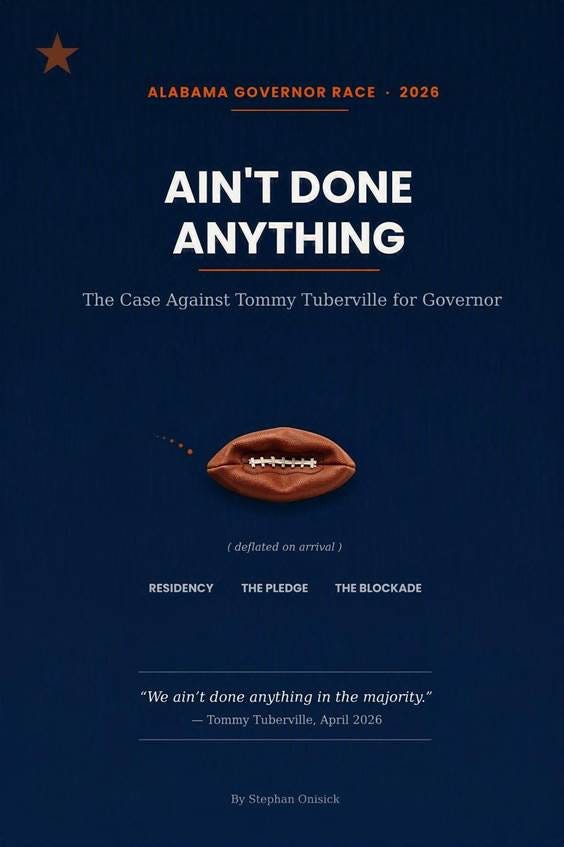
“We ain’t done anything in the majority.”
He said it about his own party’s record. It applies just as well to his promises.
“We ain’t done anything in the majority.” — Tommy Tuberville, April 2026
The Pledge
In February 2020, candidate Tuberville made a specific, repeatable promise on Birmingham radio. Not a general commitment to “support” veterans — a dollar figure.
“I’m not taking one dime, and I’m giving it to the veterans.”
He said it more than once during that campaign. He built a foundation around it. He made it a centerpiece of his pitch to a state with one of the highest per-capita veteran populations in the country.
Here’s what the paper trail shows instead.
The Washington Post’s Fact Checker column reviewed the Tommy Tuberville Foundation’s tax filings and found that in 2021, the foundation spent only about 12 percent of its revenue on its stated charitable purpose. Roughly a third went to administrative costs — including paying off a truck the charity had purchased three years earlier.
The Fact Checker also contacted the major veterans’ service organizations represented on Alabama’s State Board of Veterans Affairs. Three of them — Vietnam Veterans of America, Disabled American Veterans, and the state VFW affiliate — said they had received no donations from Tuberville or his foundation.
By mid-2026, with Tuberville giving up his Senate seat to run for governor, his office still would not directly confirm whether he had donated his roughly $437,000 in accumulated Senate salary. His own foundation’s treasurer told a reporter he couldn’t confirm it either.
Six years. One unverified promise.
Charitable giving is genuinely hard to audit from the outside, and Tuberville’s team says the foundation is being “reformed.” But a promise made on the radio to sell a Senate campaign doesn’t get graded on effort. It gets graded on whether the money showed up. As far as the record shows, for six years, it didn’t.
“I’m not taking one dime, and I’m giving it to the veterans.” — Tommy Tuberville, February 2020
The Blockade
Broken promises are one thing. Using veterans and service members as leverage is another.
For nine months in 2023, Tuberville single-handedly held up confirmation of more than 300 senior military officers — generals and admirals whose promotions are normally approved without controversy. His target wasn’t the officers. It was a Pentagon policy reimbursing travel costs for service members seeking reproductive care.
Military leadership warned the hold was straining the chain of command. Even Senate Republican Leader Mitch McConnell called it a mistake.
Eventually, Senate Democrats forced individual floor votes to get around him — confirming Gen. C.Q. Brown as Chairman of the Joint Chiefs 83 to 11, a lopsided margin that showed how isolated Tuberville’s position had become even within his own conference.
What does it say about a candidate’s priorities that hundreds of military careers became bargaining chips in a fight that had nothing to do with those officers at all?
Tuberville has defended the hold as a matter of constitutional principle — the Senate’s advice-and-consent role against what he calls executive overreach. That’s a defensible argument on its own terms.
It is much harder to defend from a man who has also branded himself, repeatedly and specifically, as the veterans’ candidate.
Even Senate Republican Leader Mitch McConnell called Tuberville’s nine-month blockade of military promotions “a mistake.”
The Residency Question
Alabama’s constitution requires seven years of continuous residency to run for governor. Tuberville says he clears that bar easily.
The record is murkier.
Voting records show Tuberville cast a ballot in Florida in November 2018. He didn’t register to vote in Alabama until March 28, 2019 — about two weeks before he announced his Senate campaign.
Voting records show Tuberville cast a ballot in Florida in November 2018. He did not register to vote in Alabama until March 28, 2019, about two weeks before announcing his Senate campaign.
Property records show the Auburn home identified as his residence was originally purchased by his wife and son in 2017, with Tuberville’s name later added to the property in 2024 and his son’s name removed.
Two separate legal challenges followed him into the primary and general election. A Montgomery judge dismissed one of them in July 2026 — not on the merits, but because she ruled she lacked jurisdiction to decide a party nominee’s eligibility before the general election. Whether Tuberville actually meets the residency requirement has never been resolved on the facts. It has been dismissed on a technicality.
That dismissal is not the end of it. The plaintiffs appealed, and the Alabama Supreme Court granted an expedited briefing schedule, with their opening brief due August 7, 2026, and Tuberville’s response due about two weeks after that.
Even the plaintiffs’ own attorney has cautioned that the court didn’t expedite the underlying case by much — the August 7 date only decides whether the appeal can move forward, not the merits of Tuberville’s residency. As of this writing, the justices haven’t ruled on either question. Nothing here is resolved.
Asked about it, Tuberville didn’t offer documentation so much as a dismissal of his own:
“These people are idiots. No, I’m good. I’m way over, as a matter of fact.”
Maybe he is. Alabama voters — and, so far, every court that has looked at the question — have not actually been shown the proof. That could change: the Alabama Supreme Court is still deciding whether the case even goes forward.
“These people are idiots. No, I’m good. I’m way over, as a matter of fact.” — Tommy Tuberville, on his residency, February 2026
The Trades
Residency isn’t the only place where Tuberville’s public role and his private ledger seem to overlap. It’s his stock portfolio.
Since taking office in 2021, Tuberville has reported roughly 1,350 stock trades — more than 98 percent of Congress, and the fifth-most of any Republican in either chamber. Quiver Quantitative puts his total disclosed trading volume at around $38 million over that span.
The volume alone isn’t the issue. It’s where the trades land. Tuberville has traded cattle and grain futures while sitting on the Senate Agriculture Committee.
He’s bought and sold defense contractors like Lockheed Martin while sitting on Armed Services. In early 2024, he was the only member of Congress reported trading Humacyte, a small biotech developing implantable tissue for combat injuries, while the company awaited an FDA review — the stock climbed 220 percent in the following month.
Tuberville says he doesn’t make the calls himself — an outside advisor handles the portfolio. That’s a common answer among Congress’s busiest traders, and trading on committee-adjacent information isn’t illegal unless prosecutors can show he acted on material, nonpublic information.
But it doesn’t explain why an advisor supposedly working without his input keeps landing trades in the exact industries Tuberville’s committee seats give him early visibility into.
He’s also one of the more vocal opponents of a congressional stock-trading ban, arguing it would just shrink the pool of people willing to serve.
Maybe it’s all coincidence. But when a sitting senator trades more than nearly everyone else in Congress, and the winning bets keep showing up in the sectors he’s positioned to know about first, “my advisor handles it” is a hard sell.
Tuberville has also been a vocal opponent of proposals to ban members of Congress from trading individual stocks. He has argued that lawmakers should be free to invest their money and has criticized congressional stock-trading bans as unfair to members who follow existing disclosure laws.
Tuberville has reported more stock trades than 98 percent of Congress — many clustered in the industries his own committees oversee.
The Pattern
Any one of these threads, on its own, has an innocent explanation. Politicians travel. Charitable foundations are hard to run well. Holds are a legitimate Senate tool. Judges dismiss cases on procedure all the time. Members of Congress are legally allowed to trade stocks.
Individually defensible.
Collectively, that’s the résumé.
Together, these threads describe a pattern: a candidate whose specific, dollar-figure promise to veterans hasn’t survived contact with his own foundation’s tax filings; whose signature Senate act used military careers as leverage; whose claim to Alabama residency has never actually been tested on the merits — dismissed on procedure at the trial court, with an appeal now pending before the Alabama Supreme Court and no ruling yet on whether that case will even go forward; and whose stock trades, over a thousand of them, keep landing in the industries his committee seats let him see first.
And in April, without any prompting from an opponent, he offered his own assessment of the balance sheet.
“We ain’t done anything in the majority.”
That’s Tommy Tuberville’s own verdict on six years in the United States Senate. Alabama is being asked to promote him.
What Alabama Deserves
A governor’s race isn’t a referendum on charisma or football. It’s a hiring decision — for the state’s chief executive, its highest steward of public trust.
On the evidence, Tommy Tuberville hasn’t shown Alabama that trust is his strong suit. Not with veterans, who were promised specific dollars and got a foundation that couldn’t account for them. Not with the military, whose promotions became a bargaining chip. And not with the basic question of where he actually lives.
Alabama can do better than a candidate who admits, in his own words, that he hasn’t done much with the power he already has.
Doug Jones spent four years in Congress voting his own name onto bills instead of hedging on his own record; whatever else you make of him, nobody’s had to subpoena him to find out where he lives.
“A promise is only as good as the dime behind it.”
— Stephan
Sources
The Premise
The Hill - Tommy Tuberville says GOP hasn’t achieved ‘anything in the majority’ - April 15, 2026
The Pledge
U.S. Senate - Senate Salaries, 1789 to Present - Accessed August 4, 2026
The Blockade
The Residency Question
Alabama Legislature - Alabama Constitution Section 117 - Accessed August 4, 2026
AP / WBRC - Tuberville faces renewed residency challenge in run for Alabama governor - June 14, 2026
WSFA - Sen. Tommy Tuberville facing another suit challenging Alabama residency - June 17, 2026
Alabama Reflector - Tommy Tuberville residency lawsuit dismissed by Montgomery judge - July 9, 2026
Alabama Reflector - Tuberville residency challenge appealed to Alabama Supreme Court - July 14, 2026
ABC 33/40 - Judge Dismisses Lawsuit Challenging Tuberville’s Residency for Governor - July 9, 2026
The Trades
Quiver Quantitative - Tommy Tuberville Trading Activity - Accessed August 4, 2026
U.S. Senate - Committee Assignments of the 119th Congress - Accessed August 4, 2026
Sen. Tommy Tuberville - Committee Assignments - Accessed August 4, 2026
Benzinga - Senator Who Opposes Ban on Congress Trading Discloses First Trades of 2026 - Jul 2026